

Assessment and evaluation are two words I hear frequently in my line of work. Sometimes they’re used interchangeably. Yet assessment and evaluation are related yet distinct processes.
What Is Assessment?
In education, assessment is the process of collecting evidence of learning or growth. Assessment is
a systematic process that plays a significant role in effective teaching. It begins with the identification of learning goals, monitors the progress students make towards those goals, and ends with a judgment concerning the extent to which those goals have been attained.1
Consider a Physical Education class in grade school. The goal, or learning outcome, is for students to run a mile in under 10 minutes. The teacher instructs students about running, has them run laps during class, and then times them on a one-mile run at the end of the unit.
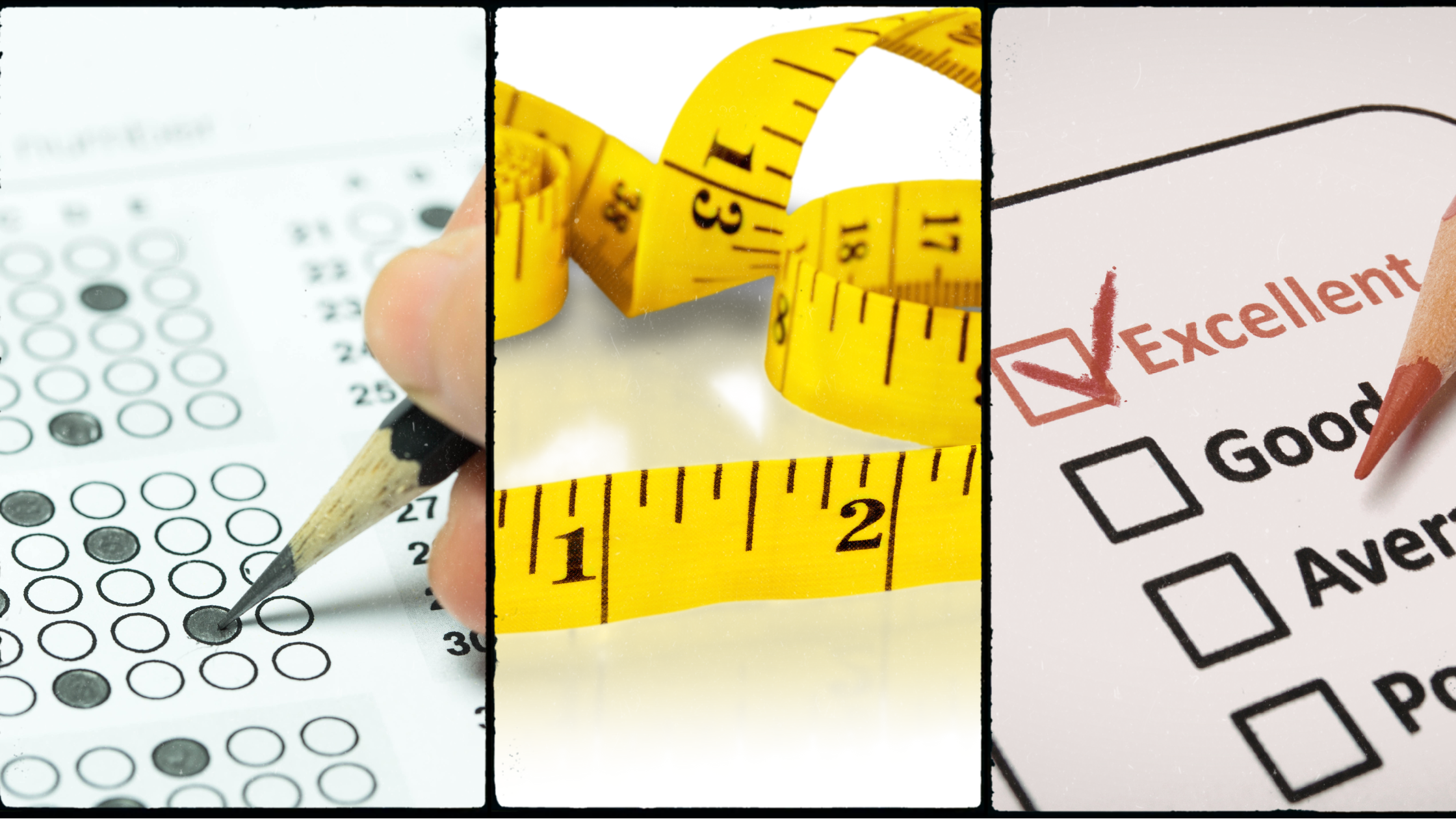
Familiar types of assessment include tests, quizzes, essays, and projects. Other types of assessment could include small group discussion contributions, presentations, playlist compositions, and food intake logs. Assessment often involves some form of measurement.
Sometimes others observe our learning and measure our growth. Other times, we participate in self-assessment, reflectively taking stock of where we are now or how far we have come.
What Is Evaluation?
Evaluation is the process of collecting evidence of a program’s effectiveness. It is
the application of systematic methods to address questions about program operations and results.2
In program evaluation, we collect data to help us understand the program’s impact on its participants as well as the program’s systems and processes.
Where Assessment and Evaluation Overlap
Program evaluation of educational programs often involves some form of assessment. For example, you might ask program participants to complete intake and exit surveys that measure their knowledge about a topic or their habits. Or you might ask participants to create a capstone project as part of the program. That project, if designed well around clear learning outcomes and supported with the right learning activities, can give you evidence of a student’s learning throughout the program.
Identifying Your Assessment and Evaluation Needs
When crafting your evaluation needs, it can be helpful to consider whether or not you need to collect evidence of participant learning or growth. If you do, then it would be wise to identify and/or develop assessment tools as part of your evaluation strategy.
- Miller, M. D., R. L. Linn, and N. E. Gronlund. (2009). Measurement and Assessment in Teaching. 10th ed. Upper Saddle River: Pearson. p. 26. ↩︎
- Newcomer, K. E., H. P Hatry, and J. S. Wholey. (2010). “Planning and designing evaluations.” Handbook of Practical Program Evaluation. 3rd Ed. J.S. Wholey, H. P. Hatry, and K. E. Newcomer, eds. San Francisco: Jossey-Bass. p. 5. ↩︎