

One of the first questions I ask clients, whether we’re working on a program design or evaluation, is What are the learning outcomes?
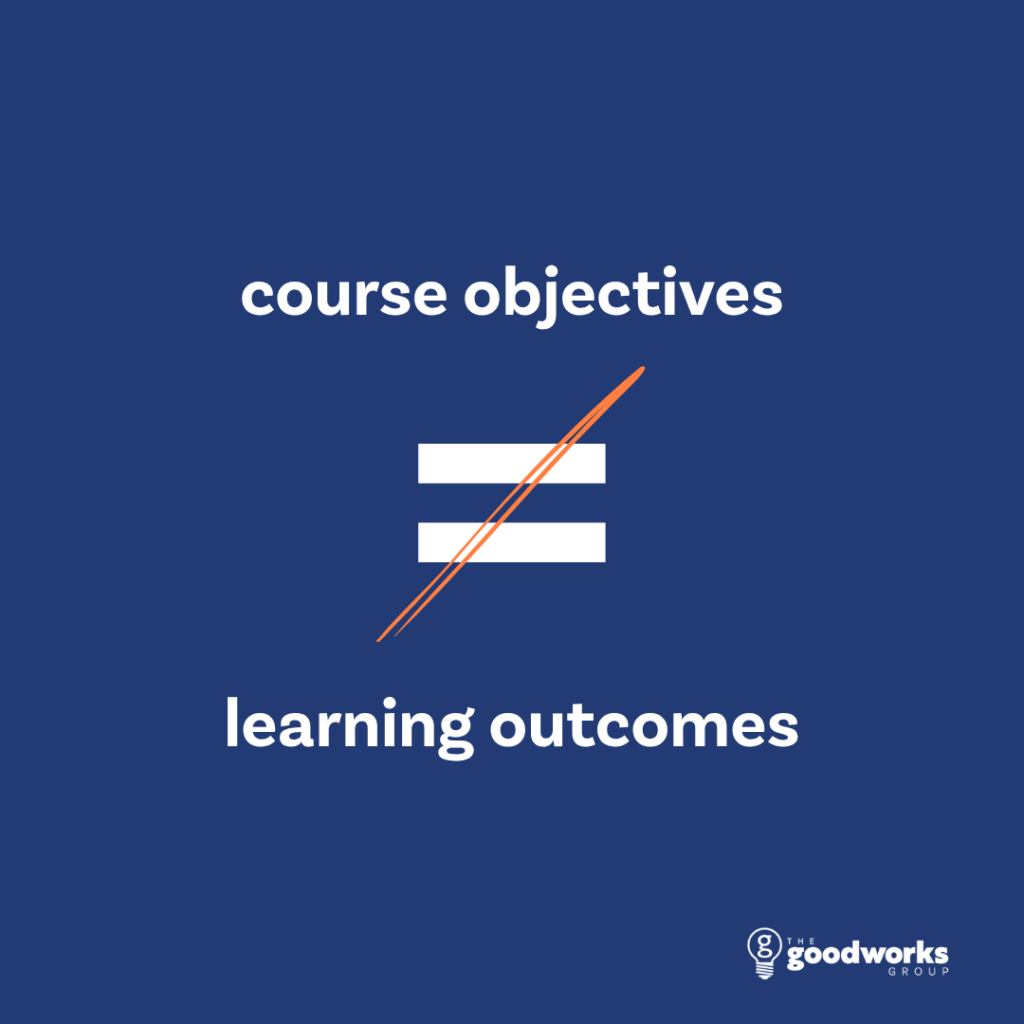
Usually, I get one of two responses. Some don’t have learning outcomes and don’t know how to create them. Others rattle off a list of course or program objectives, thinking the objectives and the outcomes are the same. Although the terms learning objectives and learning outcomes are often used interchangeably, course objectives and learning outcomes are distinct, and it is helpful to keep both in mind when designing and evaluating a program.
Course Objectives
Course objectives are the results you hope to achieve as the course designer or facilitator. Here are a few examples:
For a course on career decision-making
- To give participants new frameworks for understanding their callings
- To help participants identify the types of work they are most suited to do
- To equip participants with a process for decision-making
For a course on the New Testament
- To help participants understand the different genres in the New Testament
- To equip participants with tools to understand the historical context of the New Testament
- To teach students how to interpret passages in the New Testament and apply them to their lives today
Course objectives focus on what the course will be structured to do for the learners or participants.
Learning Outcomes
Learning outcomes, on the other hand, describe the change, learning, or growth you hope participants will experience as a result of participating in the course. They signal what the learners will know, be, and/or do at the completion of the course.
When thinking about learning outcomes, I consider transferable abilities by asking myself the question: What do I want learners to be able to do on their own, after the course, with minimal support?
Learning outcomes have a particular syntax or grammatical structure. The participants are the subject. Learning outcomes contain a strong verb followed by a description of what the learners will be able to know, be, and/or do. And they contain
Here are some examples using the career decision-making and New Testament courses above.
For a course on career decision-making.
By the end of this course, students will
- Describe how the work they hope to do relates to their sense of calling.
- Identify at least two types of work they are suited to do.
- Explain the pros and cons of two career paths.
For a course on the New Testament
By the end of this course, students will be able to
- Explain the difference between a gospel, an epistle, and apocalyptic literature.
- Describe the historical context of a passage and how it adds to our understanding of the text.
- Prepare a brief message on a New Testament passage with appropriate application to their audience.
How Course Objectives and Learning Outcomes Work Together
Course objectives and learning outcomes should clearly align. Having course objectives without learning outcomes can lead to a class that’s more teacher or content-centered than student-centered. You need both to fulfill your program’s purpose and serve your students well.
Plus, when gathering data to learn about your program’s effectiveness and impact, you will have a plumbline against which to evaluate your efforts. You’ll gain insights into what your participants have learned and how they have grown, and you will have points of reflection for considering program improvements.
Help for Developing Learning Outcomes
Creating learning outcomes seems to be more difficult for program designers than coming up with course objectives. One helpful tool I like to use when writing learning outcomes is Bloom’s Taxonomy. Bloom’s Taxonomy identifies six ways that we interact with knowledge in the cognitive domain.
For example, when our brains try to remember a mathematical formula, it requires a different process and level of thinking than when we apply that formula to solving an equation. You probably remember the Pythagorean Theorem (a2 + b2 = c2) from middle school, but can you use it to estimate the distance between two points on a map?
If we can help you develop your learning outcomes, don’t hesitate to ask. Set up a discovery call today.
And, in the meantime, you might find this guide to Objectives, Outcomes, and Outputs helpful.